
Choosing roof and siding colors for a Utah home
How to pick colors that suit your home, your neighborhood and Utah light, and how to see real samples before you commit.
Start with what isn't changing
Brick, stone, and a roof you're keeping all have fixed colors. Pick new siding and trim to work with them, not against them: warm stone usually pairs best with warm siding and trim, and gray stone with cooler tones.
Look at the whole house, not a chip
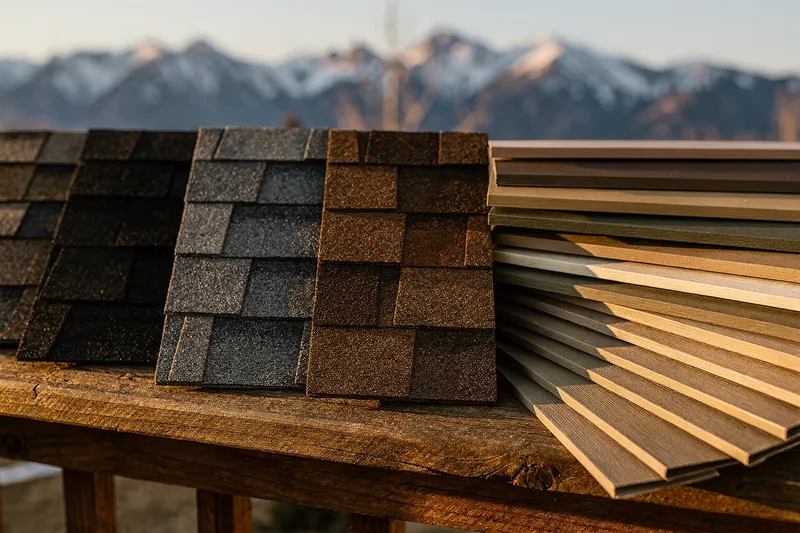
A color covers far more area on a house than on a sample, and it reads lighter in bright Utah sun. Choose one step darker than you think, and look at samples outside, on the actual wall, at more than one time of day.
Combinations that suit the Wasatch Front
- Charcoal and warm wood: dark siding, cedar or tan trim, and a black or charcoal roof. Clean and modern against mountain views.
- Warm neutrals and stone: tan or greige siding, white or cream trim, and a weathered-wood roof blend with stone accents.
- White farmhouse: white board-and-batten, black windows and gutters, and a dark metal or charcoal shingle roof.
Check the rules first
Many Utah subdivisions require HOA approval for exterior color changes. Getting that approval before ordering materials avoids a costly redo.
Request color samples
Common questions
Can I see real samples before choosing a color?
Yes, and you should. Screens and printed brochures shift colors. Ask us for physical samples and look at them outside, against your brick or stone, in morning and afternoon light.
Does my HOA have to approve a roof or siding color?
Often. Many Utah subdivisions require architectural approval for exterior color changes, even on a reroof. Check your covenants, or send them to us and we'll help put the request together.
Does roof color affect heat in the attic?
Yes. Lighter colors reflect more sunlight than dark ones, which helps keep an attic cooler in summer. Ventilation and insulation still matter more than color, so we look at all three.